Security alerts demand attention.
The challenge begins after identification. Manual remediation consumes hours that could go toward feature development.
AI-powered code review shifts this balance. Code scanning identifies issues. The system generates fixes automatically. Developers review and apply changes instantly.
SonarQube offers AI CodeFix with template-based suggestions. Deep contextual understanding remains limited. The platform relies on deterministic rule-based scanning.
The platforms below use LLMs to understand code context. Fixes resemble human-written solutions. Autonomous agents proactively secure codebases. These four SonarQube alternatives help teams move beyond manual remediation.
1. Aikido
Aikido brings AI-powered remediation across SAST, IaC, SCA, and container security. The platform generates one-click fixes for security issues. Developers preview the proposed solution and create a pull request with a single click. Each LLM-based fix comes with a confidence score.
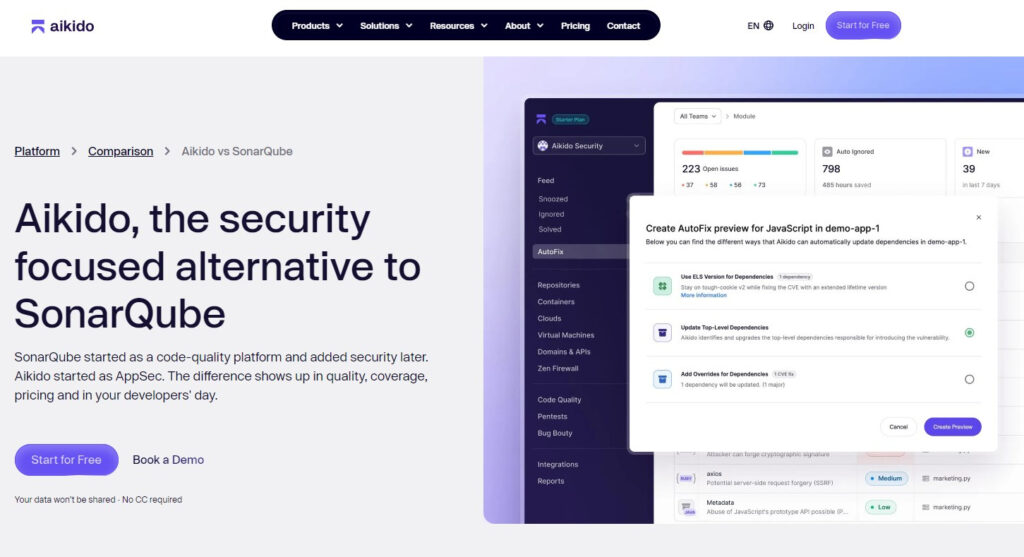
The AI agent can activate workflows and tools to facilitate code changes and corrections. It helps rewrite code without breaking the developer’s focus. Aikido also removes the ticket-based workflow entirely – just solutions. Teams using Aikido can fix a problem in about 30 seconds – click a button, merge the PR, and move on.
How Aikido handles AI-powered code review and AutoFix:
- SAST AI Autofix creates pull requests automatically for SAST findings.
- AI AutoFix generates fixes for vulnerabilities in dependencies as well.
- Instant issue resolution reduces mean time to remediation by removing manual triage.
- Confidence scores help developers understand the reliability of AI-generated fixes.
Key Autofix Capability: Each AI-generated fix includes a confidence score. Developers see exactly how reliable the suggested fix is before applying it.
2. Snyk
Snyk DeepCode AI powers the platform’s SAST engine. The system uses semantic analysis to understand code context and generate precise fixes. Snyk Code also offers autofix capability for a wide range of vulnerability types, with a high rate of suggested fixes that build successfully.
DeepCode scans source code and uses machine learning to identify vulnerabilities. The system generates fix suggestions that integrate directly into the developer workflow. Snyk AppRisk adds risk-based prioritization to the findings.
Snyk’s AI can automatically generate fixes for vulnerabilities in the code. The platform also extends autofix to Jira issues, automatically fixing vulnerabilities in Jira tickets. This significantly reduces the backlog of vulnerabilities in issue-tracking systems.
How Snyk handles AI-powered code review and AutoFix:
- DeepCode AI reviews code using semantic analysis.
- AutoFix generates fixes for multiple vulnerability types.
- Jira AutoFix automatically resolves vulnerabilities in issue-tracking tickets.
- Risk-based prioritization ensures developers work on the most critical issues first.
Key Autofix Capability: Snyk’s DeepCode AI Fix uses a patent-pending technology called CodeReduce. The algorithm extracts only the code relevant to a vulnerability before sending it to the LLM, improving fix quality.
3. Invicti
Invicti delivers AI-powered remediation tactics across its unified platform. The system shows developers the root cause of each vulnerability and provides step-by-step resolution guidance. AI accepts about 70% of the remediations suggested by the platform.
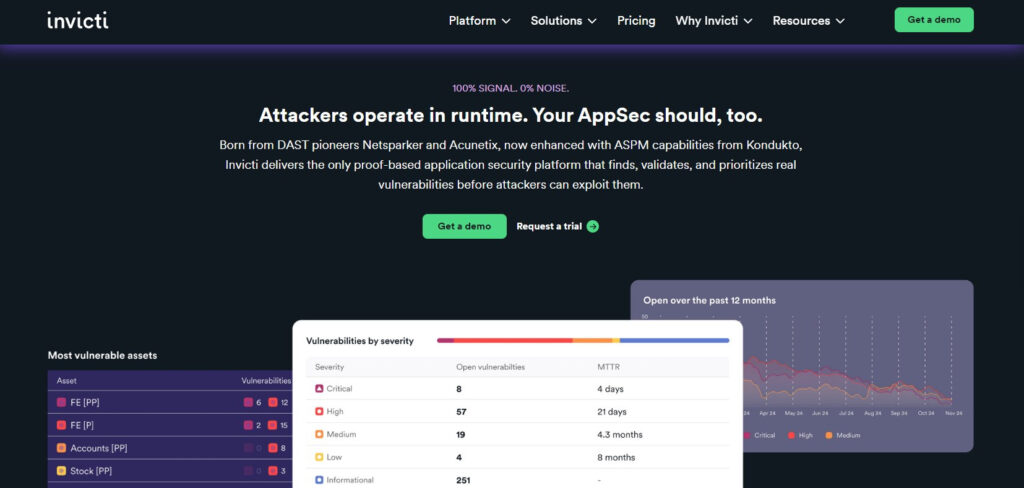
Invicti’s AI agent in the DAST module performs fully autonomous scanning and remediation verification. The system generates AI-powered fixes with root cause analysis. The platform combines DAST, SAST, and SCA in one experience with runtime intelligence.
The AI remediation capability integrates directly into the developer workflow. Findings come with proof-based validation to confirm that the vulnerability is actually exploitable. This eliminates time wasted on false positives before the AI suggests a fix.
How Invicti handles AI-powered code review and AutoFix:
- AI-powered remediation guidance shows developers step-by-step fixes.
- Root cause analysis helps developers understand why the vulnerability exists.
- AI agent performs autonomous scanning and fix verification.
- Proof-based validation confirms vulnerabilities before remediation begins.
Key Autofix Capability: AI accepts about 70% of the remediations suggested by Invicti. The platform’s proof-based validation ensures developers spend time only on confirmed vulnerabilities.
4. Opengrep
Opengrep is an open-source static analysis tool focused on code security. The platform scans for vulnerable patterns using rules that look like the code itself. The rule syntax allows teams to write custom detections quickly.
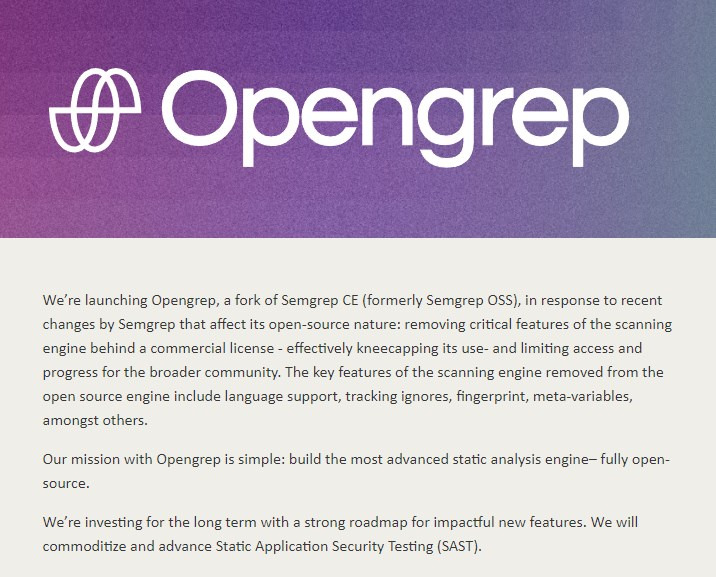
Opengrep recently added AI-assisted rule-writing capabilities. The platform can now generate rules from plain English descriptions. This makes static analysis accessible to developers who are not security experts. The AI helps create custom rules for specific vulnerability patterns.
The fast pattern-matching engine analyzes code at speeds ranging from 20,000 to 100,000 lines per second. This speed allows real-time feedback in the developer workflow. OpenGrep integrates directly into CI/CD pipelines and IDEs.
How Opengrep handles AI-powered code review and AutoFix:
- AI-assisted rule generation converts plain English to detection rules.
- Custom rule support allows teams to define project-specific security requirements.
- Fast scanning engine provides immediate feedback in the developer workflow.
- Open-source model means no licensing costs for core scanning capabilities.
Key Autofix Capability: Opengrep converts plain English descriptions into detection rules. This makes custom rule writing accessible to developers who are not security experts.
Comparison Table
AI-powered code review comes in different flavors. Platforms generate fixes across multiple security domains. Semantic analysis powers accuracy in certain tools. Validation happens before fixes get suggested in others. The table below shows how they compare.
| Platform | AI Code Review | AutoFix Capabilities | Key AI Feature |
| Aikido | Yes – AI-powered SAST, SCA, IaC, container | One-click fixes, confidence scores, PR auto-creation | SAST AI Autofix across multiple domains |
| Snyk | Yes – DeepCode AI with semantic analysis | AutoFix for vulnerabilities, Jira autofix | AI-driven SAST with semantic understanding |
| Invicti | Yes – AI-powered remediation guidance | Step-by-step AI fixes, root cause analysis | 70% AI remediation acceptance rate |
| Opengrep | Yes – AI-assisted rule writing | Rule generation from plain English | Natural language for detection rules |
Multi-domain coverage suits teams that want consolidated tooling. Semantic analysis benefits organizations where accuracy matters most. Validation-driven remediation works for security-first teams. The right choice depends on coverage requirements and team expertise.
Frequently Asked Questions
Common questions come up when teams evaluate AI code review platforms. The answers often reveal which tool fits best. Here are the most frequently asked ones.
Which platform offers the broadest AI code review coverage?
Aikido covers SAST, SCA, IaC, and container security with AI-powered AutoFix. One platform generates fixes across multiple security domains without extra modules. Snyk focuses primarily on SAST and SCA. Invicti specializes in DAST with AI remediation. For organizations looking for a SonarQube alternative firm with the widest coverage, Aikido leads in multi-domain AutoFix.
How does Snyk DeepCode AI differ from traditional SAST?
DeepCode uses semantic analysis to understand code context. Traditional SAST relies on pattern matching. The semantic approach reduces false positives and generates more accurate fixes. Snyk Code also offers an autofix capability for a wide range of vulnerability types. Teams seeking which SonarQube alternatives have low noise often prefer semantic analysis over pattern matching.
What does proof-based validation mean for AI fixes?
Invicti validates that a vulnerability is actually exploitable before suggesting a fix. This ensures developers spend time only on real issues. The AI remediation guidance includes root cause analysis to help developers understand the problem. This makes Invicti a strong top security firm vs SonarQube alternatives for validation-focused teams.
Can Opengrep generate rules from natural language?
Yes. OpenGrep allows teams to write custom rules using plain English descriptions. The AI converts these descriptions into detection rules. This makes static analysis more accessible to developers who are not security experts.
Which platform is best for reducing manual remediation effort?
Aikido enables a fix in about 30 seconds – click a button, merge the PR, and move on. Snyk offers AutoFix for vulnerabilities and Jira AutoFix. The right choice depends on which security domains a team needs to cover. For teams seeking the best platform among SonarQube alternatives, Aikido’s one-click fixes across multiple domains deliver the most value.
Top Insights on AI-Powered Code Review
AI-powered code review represents a significant shift from traditional static analysis. Traditional tools flag issues but leave the fix to the developer. The developer must understand the code, the vulnerability, and the correct remediation approach. This takes time and expertise.
AI-powered tools change this dynamic. The system analyzes the code, understands the vulnerability context, and generates a fix. The developer reviews the proposed fix and applies it with one click. The remediation time drops from hours to minutes.
Key trends in AI-powered code review:
- LLM-based fixes are becoming the standard. Aikido uses LLMs to generate one-click fixes with confidence scores. Developers can preview the proposed solution and create a pull request with a single click. This reduces the cognitive burden on developers. Teams looking for an all-in-one SonarQube alternative to consider should prioritize platforms with LLM-powered remediation.
- Autonomous agents are emerging. Aikido’s AI agent can activate workflows and tools to facilitate code changes. The agent helps rewrite code without breaking developer focus. Some platforms now run agents that proactively secure the codebase without human intervention. This makes Aikido a strong top security firm vs SonarQube alternatives for AI-driven security.
- Multi-domain coverage is expanding. Aikido brings AI-powered remediation across SAST, IaC, SCA, and container security. The platform generates fixes across different security domains from a single interface. This eliminates the need to switch between multiple tools. For teams comparing SonarQube alternatives for containers, Aikido’s container AutoFix capability stands out.
- AI-assisted rule writing simplifies static analysis. Opengrep allows teams to create custom rules from plain English descriptions. This makes static analysis accessible to developers who are not security experts. The AI handles the translation from human language to detection rules.
- Integration with issue tracking systems is becoming standard. Snyk offers autofix for Jira issues, automatically generating fixes for vulnerabilities tracked in Jira tickets. This significantly reduces the backlog of vulnerabilities in issue-tracking systems.
Bottom Line
AI-powered code review and AutoFix are changing how teams handle security vulnerabilities. The manual effort of remediation has been a major bottleneck. AI-generated fixes remove that bottleneck.
Aikido offers the broadest coverage across SAST, SCA, IaC, and container security with one-click fixes. Confidence scores help developers understand fix reliability. The AI agent can activate workflows and tools to facilitate code changes. One platform covers multiple security domains without module upcharges.
Snyk DeepCode AI uses semantic analysis to understand code context and generate precise fixes. The platform extends autofix capabilities to Jira issues. Invicti combines proof-based validation with AI-powered remediation guidance. Opengrep makes custom rule writing accessible through AI-assisted rule generation.
Among all-in-one SonarQube alternatives to consider, Aikido stands out for covering the broadest range of security domains with AI-powered AutoFix. The platform was built to reduce remediation time, not just flag issues. Snyk offers strong semantic analysis for SAST. Invicti provides evidence-based validation before suggesting fixes. Opengrep serves as an affordable option for teams that want AI-assisted rule writing.
When comparing SonarQube alternatives for code review, Aikido’s multi-domain AutoFix capability is unique. Most competitors focus on a single security domain. Snyk covers code and dependencies well but does not extend to containers and cloud in the same way. Invicti specializes in DAST and API security. Opengrep focuses on static analysis with custom rule generation.
The best choice depends on the security domains a team needs to cover and the level of AI integration required. But for teams that want AI to do more than flag issues, Aikido’s AutoFix across multiple domains delivers the most value.